Showing posts with label Twitter. Show all posts

Saturday, February 18, 2012

Social Media Timeline

The history of social media in a timeline format (info graphic) is a useful tool for teacher librarians and others.  For many, it is a walk down memory lane.  See the full timeline at http://www.siliconrepublic.com/new-media/item/25854-the-history-of-social-media


Add some education data points:

  • 1994 - Net Day, an initiative to wire all schools and classrooms (and school libraries) to the Internet.  That is also when it became clear that schools needed to upgrade their electrical system.  Computers need to be plugged into electrical outlets.  This is also the year that Pacific Bell (now AT&T) started its Education First initiative and team, got CPUC approval to donate three years of ISDN lines for Internet access and interactive videoconferencing to all California schools, libraries and community colleges, and established 12 demonstration sites.  Library sites included Pasadena Public Library and Sacramento Public Library.
  • 1996 - Telecommunications Act of 1996 included a section on Universal Service that helps schools and public libraries obtain access to state of the art telecom services and equipment at a discounted rate.  This became known as "E-Rate", short for "eduction rate."
  • Summer 2007 - California School Library Association offered its free, online web 2.0 tutorials, School Library Learning 2.0 and Classroom Learning 2.0  
Add your own special dates and memories to the timeline!

Thursday, August 5, 2010

California School Library Association Sweet Tweets

The California School Library Association (CSLA) has a new social networking task force consisting of two techie teacher librarians, one representing Northern California (NorCal) and one representing Southern California (SoCal). They have set up a wiki Twitter page for CSLA members to add their twitter addresses so members can get their "web feet" wet by following friends and learning how to effectively use the social networking tool.

Thanks go to CSLA social networking stars Anna Koval (NorCal) and Marie Slim (SoCal). Anna and Marie say: "Try Tweeting! Follow your fellow CSLA members and add your name to the list! Use a #CSLA hashtag for general school library tweets and #calibconf for Annual Conference tweets!"

Tuesday, March 16, 2010

Social Media Online Guide

Here's a colorful and useful guide to social media from SMO.com that is downloadable. It includes 10 websites (left column) by customer communication, brand exposure, traffic to your site, and SEO (search engine optimization).

Websites covered include:
Decorate your library, lab, office, or classroom.

Saturday, January 2, 2010

Social Media - A Force for Good (video)

Marin, CA Teacher Librarian Tom Kaun recommended a panel discussion on "Social Media as a Force for Good" with Twitter and LinkedIn founders and UK author/activist Stephen Fry. It was well worth the time (1.5 hours).

Stephen Fry said he got the most joy from Twitter about a year or so ago when he decided to use Twitter as "verbal post cards" for a trip to Africa to do a story on Rhinos. He suddenly got thousands of followers and started to realize the power and potential of Twitter. He also pointed out that humans are emotional creatures and need to communicate. Writing -- even on Twitter -- is a literary form. Twitter is an instrument of free speech.

Biz Stone (CEO/Founder, Twitter) said early on he saw how Twitter was used for "Tweet-ups" (like "meet-ups") to organize events or meetings. People in a conference session would tweet that a different session was more interesting, and lots of people like a flock of birds would leave the first session to go to the better session. Similar use of "Tweet-ups" for raising money for a charity, to do good. Biz said Twitter was created to do good.

Biz also said Twitter was created with mobile devices in mind, and mobile devices are growing way faster than desktop computers. Re: Twitter as news media -- it is good for breaking news, but journalists are better for putting news in context.

LinkedIn's Reed Hoffman, in commenting about social media trends, said "you haven't seen anything yet." "Web 2.0 is power to the people, a '60's expression." Social networking sites are platforms upon which other sites are built ("platforms" rather than "features" on a site.)

Monday, November 30, 2009

TweetCloud

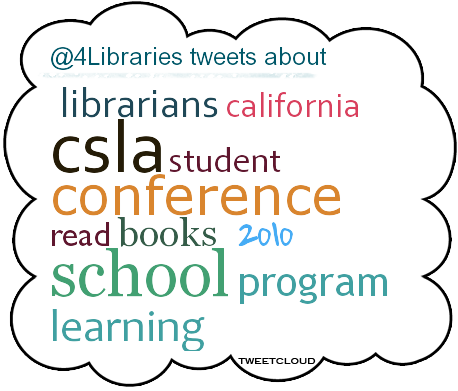
TweetCloud is a handy application for seeing your top Twitter topics. Here is an example of my last month's tweet topics -- makes sense, given last month was the California School Library Association Conference.

How to use it? One way is to use a TweetCloud to make sure you are staying focused and not tweeting about off-topic subjects. Another way to use it is to capture fun word clouds for a blog, website, or newsletter article -- just tweet about a topic for a day and make a one-day TweetCloud (rather than a month or so).

Saturday, November 28, 2009

Twitter - First Follower

There are apps for everything. Today, I learned of a Twitter application that tells you the Twitter name of your first Twitter "follower". I clicked the link and learned that it was teacher librarian and CSLA 2009 conference committee member devoted to social networking, Marie Slim. Makes sense! First Follower is simple. Click on the link and there are three action items:
  1. A question: "Wanna know who was your first follower?"
  2. Box to type in "Your Twitter Nick" (your nickname, such as 4Libraries)
  3. Box to click that says "Wanna Know"
Twitter originally was created for a small entrepreneurial team that needed to stay connected and focused on building their business. Back then, the key question they'd ask one another was "What's happening?" That is the simplicity of Twitter.

There are lots of Twitter apps that I'm just learning to explore.


Saturday, November 7, 2009

Word-of-the-Day - tweets in all languages

The 11/4/09 issue of American Libraries Direct carried an item from Makeuseof.com that eventually directed me to the Transport.com website and Word of the Day in Spanish. The company offers a lot of language products for sale, but also a handful of free practical tools such as Word-of-the-Day. Spanish word-of-the-day twitter = @SpanishLanguage

School, academic, and public librarians could easily offer this educational tool as a resource for foreign or English language learners (ELL). To gradually learn or strengthen foreign language skills, it makes sense to incorporate everyday tools like Twitter, search engines, RSS feeds and such.

Footnote: Here is a NYT map of ELL titled "New to English". Visuals like this map make a lasting impression. Check it out.

Saturday, October 24, 2009

TwitterFeed, RT, and other Twitter Tricks 'n' Tools

Read a free PDF book by Mark O'Neill on "The Complete Guide to Twitter". Learned of a way to promote my blog posts through registering them on Twitterfeed.com. Apparently, it is an effective way of promoting a blog or website, especially to those who rely on their handheld mobile devices rather than RSS feeds. Now to experiment with posting here and on my other blogs and see if they are sent to my twitter account, 4Libraries.

Retweeting a tweet (p.21) apparently is similar to sharing a blog post. Retweets are useful because if lots of other Tweeters retweet something, then a web link or an idea could go viral. Humm. Here are some examples to consider for California school librarians:
  • If I tweeted about the California School Library Association's online web 2.0 tutorial Classroom Learning 2.0, and other CSLA members retweeted (RT) about it and mentioned the URL, visitor statistics for the site could jump, bigtime.
  • If someone tweeted about new legislation or new draft school library standards for California, and school teacher librarians and advocates around the state retweeted (RT), this would raise the visibility and timing of the school library standards.
  • If each CSLA member tweeted about each new library advocate or "Best Seller" for strong school libraries, then other CSLA members retweeted (RT) and congratulated or cheered about the newest "Best Seller", that would increase the awareness and significance of strong school libraries and academic achievement -- and potentially increase the number of new "Best Sellers" for this grassroots library advocacy campaign.
  • Tweets and retweets would be useful for promoting workshops, conference programs, and all sorts of events -- especially as more of the target audience (i.e., librarians) used or followed Twitter.

Saturday, July 25, 2009

Twitter Tips

Mashable carried a useful article on 7/20/09 by Josh Catone on "Twitter for Beginners: Five Steps for Better Tweeting".
  1. Find people you already know. Find them. Follow them.
  2. Find Like-minded Users.
  3. Find People in the area.
  4. Get a desktop or mobile client (upgrade from web interface).
  5. Learn the ropes.